Summary Analysed coins Analysis
Summary
This analysis compares the weights of pre-Hellenistic and early Hellenistic staters from Aspendos and pre-Hellenistic staters from Tarsos issued under the satraps from Tiribazos to Balakros with those of pre-Hellenistic staters from the mints of Cilicia Trachea. The results suggest that different weight standards may have been used simultaneously in these areas during at least part of the pre-Hellenistic period. Moreover, it seems that the weight standard did not necessarily decrease over time, i.e., that the relative chronology of coin types cannot be inferred from a decrease in weight standard alone. However, some observed differences in coin weights may have resulted from factors other than different weight standards, such as differences in seigniorage or metal quality, which may have caused different degrees of weight loss through physico-chemical processes affecting the surviving coins over time. In addition, firmer conclusions would require analysis of the coinage of Tarsos before 388 BC and larger analysed datasets to improve their representativeness.
Analysed coins
The numbers of analysed coins are given in Table 1. Coins whose weight is unknown or unreliable, or that are excessively corroded or damaged, are excluded from the analysis.
| Corpus | Number of coins as of 2 November 2025 | ||
|---|---|---|---|
| Total | Excluded | Analysed | |
| Anemourion | 2 | 2 | |
| Aphrodisias, Staters | 4 | 4 | |
| Holmoi, Group 1, staters | 9 | 9 | |
| Holmoi, Group 2, staters | 9 | 1 | 8 |
| Kelenderis, Staters – Group 1 | 14 | 1 | 13 |
| Kelenderis, Staters – Group 2 | 249 | 1 | 248 |
| Kelenderis, Staters – Group 3 | 272 | 4 | 268 |
| Nagidos, Staters – Group 1 | 143 | 1 | 142 |
| Nagidos, Staters – Group 2 | 249 | 1 | 248 |
| Nagidos, Staters – Group 3 | 202 | 7 | 195 |
| Pseudo-Kelenderis mints | 20 | 2 | 18 |
| Aspendos, Staters, Warrior | 63 | 63 | |
| Aspendos, Staters, Wrestlers | 292 | 292 | |
| Tarsos, Staters, Tiribazos | 35 | 35 | |
| Tarsos, Staters, Pharnabazos | 88 | 1 | 87 |
| Tarsos, Staters, Datames | 104 | 104 | |
| Tarsos, Staters, Mazaios | 102 | 102 | |
| Tarsos, Staters, Balakros | 62 | 62 | |
Table 1: Numbers of analysed coins
Analysis
The Aspendos staters are divided into early issues with a warrior on the obverse and a triskeles on the reverse, and later issues with two wrestlers on the obverse and a slinger on the reverse; the latter are further divided into five series according to Tekin 1997. The Tarsos satrapal staters are divided by individual Cilician satraps, represented by the major coin types for which sufficient data are available (see Section Tarsos, staters after c. 388 BC in the Coin Corpus). An overview of the analysed groups of Aspendos and Tarsos coins is given in Table 2.
| Mint | Group | Approximate dating | |
|---|---|---|---|
| Aspendos | Warrior / Triskeles | 465 – 430 BC | |
| Wrestlers / Slinger | Tekin 1997, Series 1 | 420 – 410 BC | |
| Tekin 1997, Series 2 | 415 – 400 BC | ||
| Tekin 1997, Series 3 | 400 – 380 BC | ||
| Tekin 1997, Series 4 | 380/75 – 330/25 BC | ||
| Tekin 1997, Series 5 | 330/25 – 310/250 BC | ||
| Tarsos | Tiribazos | 388 – 380 BC | |
| Pharnabazos | 380 – 374/3 BC | ||
| Datames (Tarkumuwa) | 384 – 361/0 | ||
| Mazaios | 361/0 – 334 | ||
| Balakros | 333 – 323 BC | ||
Table 2: Analysed groups of coins of Aspendos and Tarsos
Box plots1 of the Aspendos staters are shown in Figure 1. This chart indicates that the coins were minted to the same weight standard (perhaps with the exception of Series 4, which suggests a slight decrease). However, Series 5 was minted to a significantly lower weight standard. In addition, the greater variability in weight and the uncertain minting period of Series 5 suggest that it may not have been a homogeneous series, but that there may have been a further lowering of the weight standard during this period.

Figure 1: Aspendos, box plots
Box plots of the Tarsos staters are shown in Figure 2. In the case of the staters minted under Tiribazos, the coins are lighter than those issued under the other satraps, and the highest weight standard appears to have been used under the last two satraps, Mazaios and Balakros.
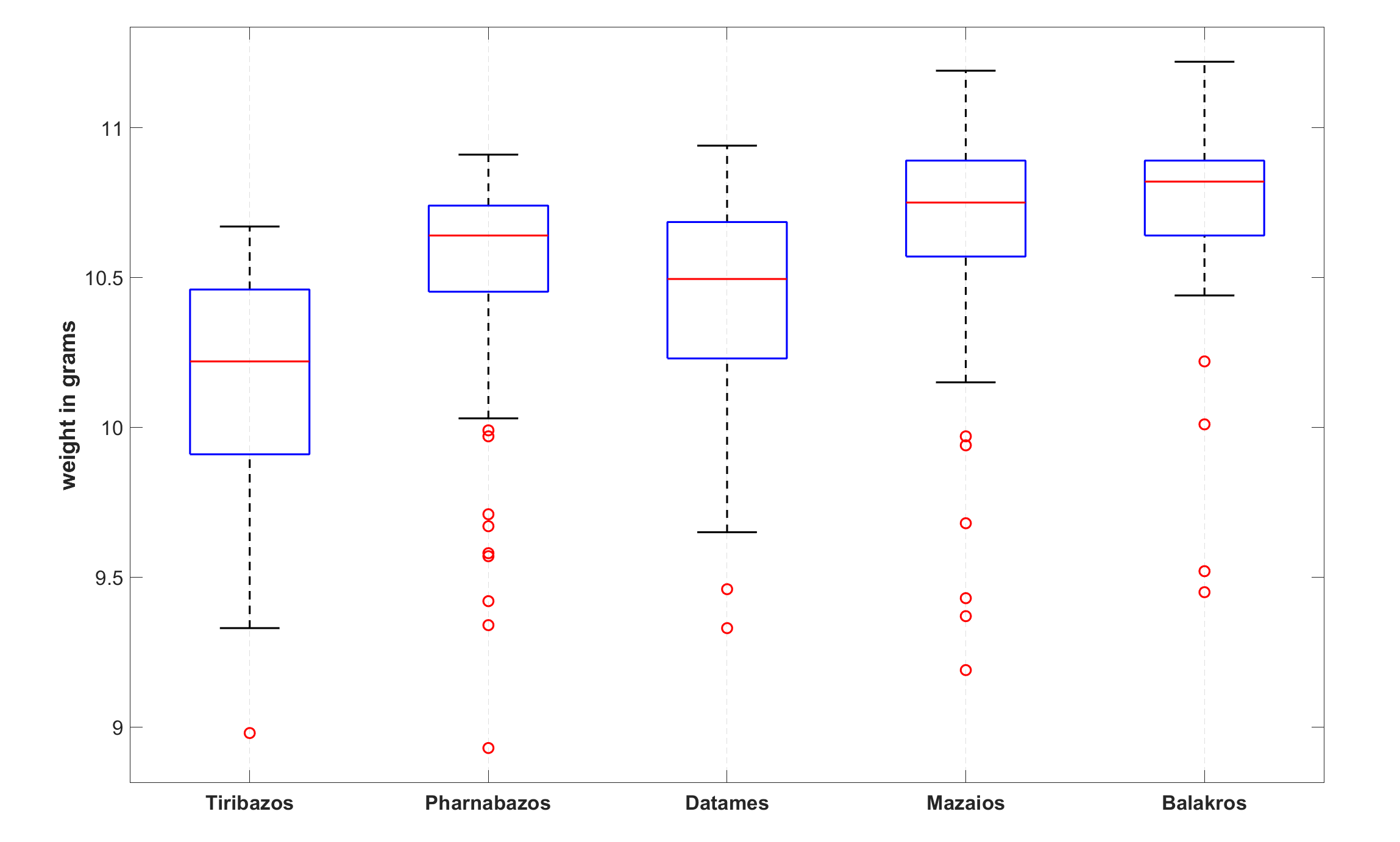
Figure 2: Tarsos, box plots
Pre-Hellenistic staters of Cilicia Trachea can be divided into the following groups (see the relevant catalogue sections and, for Kelenderis and Nagidos, also their weight analyses):
| Holmoi: | Group 1: | Type 1; |
| Group 2: | Type 2. | |
| Kelenderis: | Group 1: | Types 1.1–3; |
| Group 2: | Types 2.1–12; | |
| Group 3A: | Types 3.1–3 and 3.7–12; | |
| Group 3B: | Types 3.13–14; | |
| Group 3C: | Types 3.4–6 and 3.15–17. | |
| Nagidos: | Group A: | Group 1 except Type 1.5e; |
| Group B: | Group 2 except Type 2.8; | |
| Group C: | Group 3 with Types 1.5e and 2.8. | |
| Pseudo-Kelenderis: | Group 1: | Type 1; |
| Group 2: | Type 2. |
According to Section Staters of Cilicia Trachea, these coins can be divided into two large groups based on the similarity of their weights, which probably correspond to the two phases of the weight standard development in pre-Hellenistic Cilicia Trachea:
| Phase 1: | Holmoi, Group 1; Kelenderis, Groups 1, 2, 3A and 3B; Nagidos, Groups A and B; Pseudo-Kelenderis, Group 1. |
| Phase 2: | Anemourion; Aphrodisias; Holmoi, Group 2; Kelenderis, Group 3C; Nagidos, Group C; Pseudo-Kelenderis, Group 2. |
Figure 3 shows all the mints of Cilicia Trachea and the mints of Aspendos and Tarsos together. In Figure 4, the Cilicia Trachea coins are aggregated into the above two phases. For clarity, in both charts the Aspendos box plots have a light red background and the Tarsos box plots a light green background. The basic statistical characteristics of all these coin groups are presented in Table 3 (Std. Dev. denotes the standard deviation, IQR the interquartile range and CV the coefficient of variation).

Figure 3: Box plots of all analysed mints
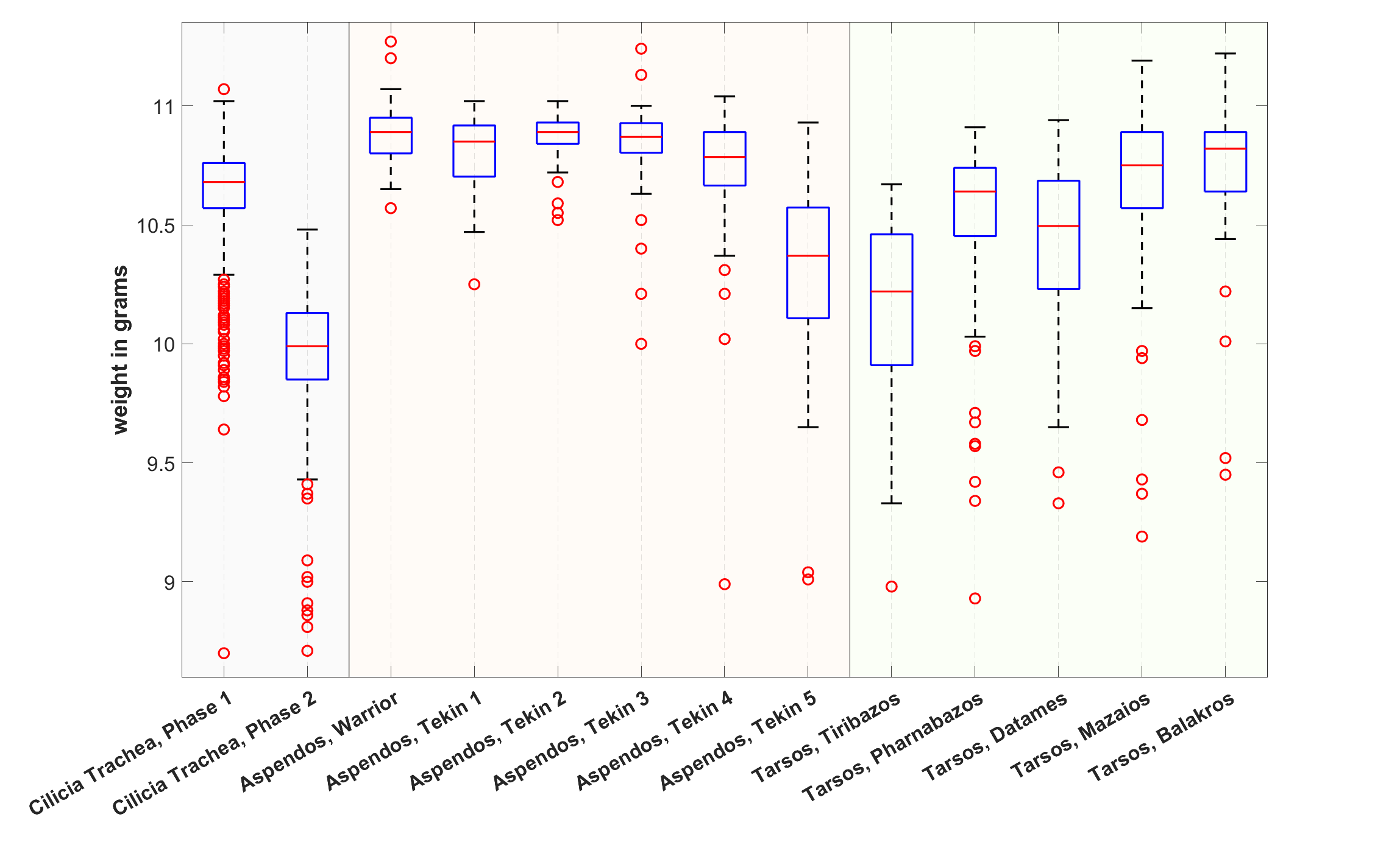
Figure 4: Box plots of all analysed mints with Cilicia Trachea aggregated into two phases
| Mint | Count | Mean | Median | Std. Dev. | IQR | CV |
|---|---|---|---|---|---|---|
| Anemourion | 2 | 9.66 | 9.66 | 0.21 | 0.29 | 0.02 |
| Aphrodisias | 4 | 9.93 | 9.92 | 0.04 | 0.07 | 0.00 |
| Holmoi, Group 1 | 9 | 10.55 | 10.66 | 0.22 | 0.18 | 0.02 |
| Holmoi, Group 2 | 8 | 9.95 | 9.97 | 0.21 | 0.34 | 0.02 |
| Kelenderis, Group 1 | 13 | 10.73 | 10.78 | 0.23 | 0.21 | 0.02 |
| Kelenderis, Group 2 | 248 | 10.72 | 10.74 | 0.10 | 0.14 | 0.01 |
| Kelenderis, Group 3A | 204 | 10.61 | 10.66 | 0.25 | 0.19 | 0.02 |
| Kelenderis, Group 3B | 16 | 10.48 | 10.49 | 0.19 | 0.37 | 0.02 |
| Kelenderis, Group 3C | 48 | 9.93 | 9.98 | 0.29 | 0.22 | 0.03 |
| Nagidos, Group A | 128 | 10.51 | 10.55 | 0.22 | 0.25 | 0.02 |
| Nagidos, Group B | 244 | 10.62 | 10.66 | 0.20 | 0.17 | 0.02 |
| Nagidos, Group C | 213 | 9.94 | 9.99 | 0.27 | 0.30 | 0.03 |
| Pseudo-Kelenderis, Group 1 | 17 | 10.61 | 10.69 | 0.28 | 0.32 | 0.03 |
| Pseudo-Kelenderis, Group 2 | 1 | 10.04 | 10.04 | 0.00 | 0.00 | 0.00 |
| Cilicia Trachea, Phase 1 | 879 | 10.63 | 10.67 | 0.21 | 0.19 | 0.02 |
| Cilicia Trachea, Phase 2 | 276 | 9.94 | 9.98 | 0.27 | 0.28 | 0.03 |
| Aspendos, Warrior | 63 | 10.88 | 10.89 | 0.12 | 0.15 | 0.01 |
| Aspendos, Tekin 1 | 19 | 10.79 | 10.85 | 0.19 | 0.21 | 0.02 |
| Aspendos, Tekin 2 | 57 | 10.87 | 10.89 | 0.10 | 0.09 | 0.01 |
| Aspendos, Tekin 3 | 51 | 10.82 | 10.87 | 0.23 | 0.12 | 0.02 |
| Aspendos, Tekin 4 | 96 | 10.74 | 10.79 | 0.26 | 0.23 | 0.02 |
| Aspendos, Tekin 5 | 69 | 10.25 | 10.37 | 0.55 | 0.46 | 0.05 |
| Tarsos, Tiribazos | 35 | 10.15 | 10.22 | 0.41 | 0.55 | 0.04 |
| Tarsos, Pharnabazos | 87 | 10.52 | 10.64 | 0.38 | 0.29 | 0.04 |
| Tarsos, Datames | 104 | 10.43 | 10.50 | 0.33 | 0.45 | 0.03 |
| Tarsos, Mazaios | 102 | 10.68 | 10.75 | 0.34 | 0.32 | 0.03 |
| Tarsos, Balakros | 62 | 10.73 | 10.82 | 0.31 | 0.25 | 0.03 |
Table 3: Descriptive statistics
These graphs and Table 3 allow the following observations in terms of mean and median weights:
- It seems that staters falling into Phase 1 of the Cilicia Trachea coinage were slightly lighter than the Aspendos staters of the warrior/triskeles type and Tekin’s Series 1–4.
- The weights of staters falling into Phase 2 of the Cilicia Trachea coinage were considerably lower than all Aspendos issues.
- The weights of the Tarsos staters minted under Tiribazos were lower both than those issued under the subsequent satraps and than those of the Aspendos staters of the warrior/triskeles type and Tekin’s Series 1–4. The weights of Tiribazos’s staters are, however, comparable to those of the late Aspendos staters of Tekin’s Series 5.
- The weights of the Tarsos staters were highest under the last two satraps Mazaios and Balakros, and the weights of their coins are comparable to Tekin’s Series 4.
These observations raise the question of whether Cilicia Trachea and Pamphylia used the same Persian weight standard, or whether multiple weight standards were used simultaneously in these areas at least for part of the pre-Hellenistic period. Moreover, the observations regarding Tarsos indicate that coin weights did not necessarily decrease over time, i.e., that the relative chronology of coin types cannot be inferred from a decrease in weight standard alone. In all these considerations, however, it is necessary to take into account that some of the observed differences described above may be due to factors other than different weight standards, such as differences in seigniorage or metal quality, which may have caused different degrees of weight loss through physico-chemical processes affecting the surviving coins over time. In addition, firmer conclusions would require analysis of the coinage of Tarsos before 388 BC and larger analysed datasets to improve their representativeness.
1The bottom and top of each box are the 25th and 75th percentiles of the dataset, respectively (the lower and upper quartiles). Thus, the height of the box corresponds to the interquartile range (IQR). The red line inside the box indicates the median. Whiskers (the dashed lines extending above and below the box) indicate variability outside the upper and lower quartiles. Above the upper quartile, a distance of 1.5 times the IQR is measured, and a whisker is drawn up to the largest observed data point in the dataset that falls within this distance. Similarly, below the lower quartile, a distance of 1.5 times the IQR is measured, and a whisker is drawn down to the smallest observed data point in the dataset that falls within this distance. Observations beyond the whisker length are marked as outliers and are represented by small red circles.
5 May 2024 – 20 September 2026