Coin types included in this section are usually assigned to Kelenderis or are described as imitations of the Kelenderis mint. Despite the similar composition both on the obverse and the reverse, these coins are in many ways significantly different from the production of Kelenderis. It appears to be a short-lived production by an as yet unidentified two separate mints, which used the Kelenderis coins only as a loose model. These Pseudo-Kelenderis mints were probably also located in Cilicia Trachea or possibly in some nearby area of the eastern Mediterranean. For details and iconographic analysis, see Veselý 2023, pp. 30–35.
AR Staters
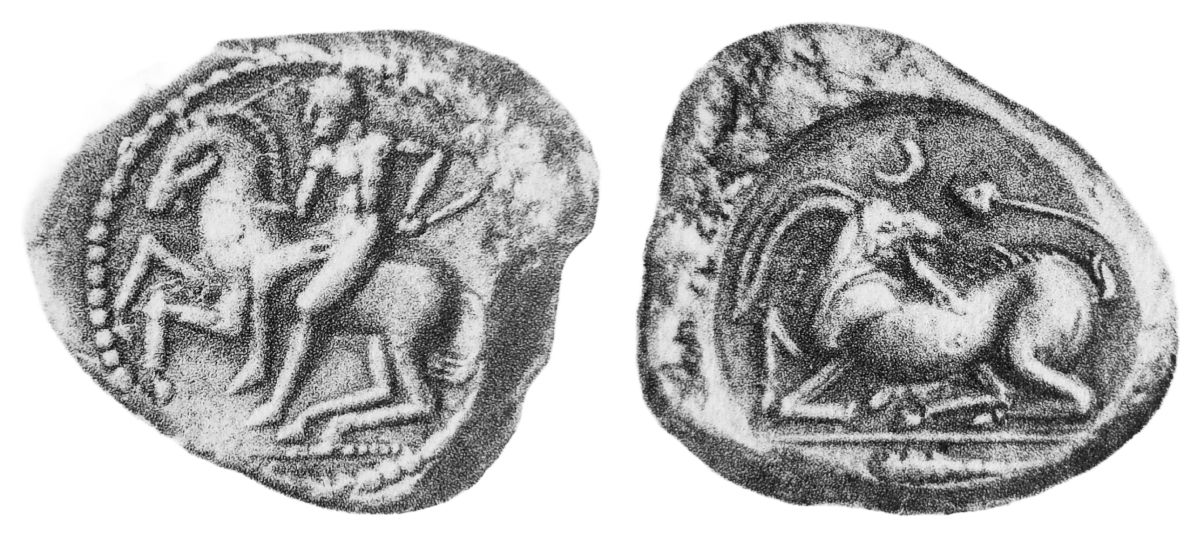
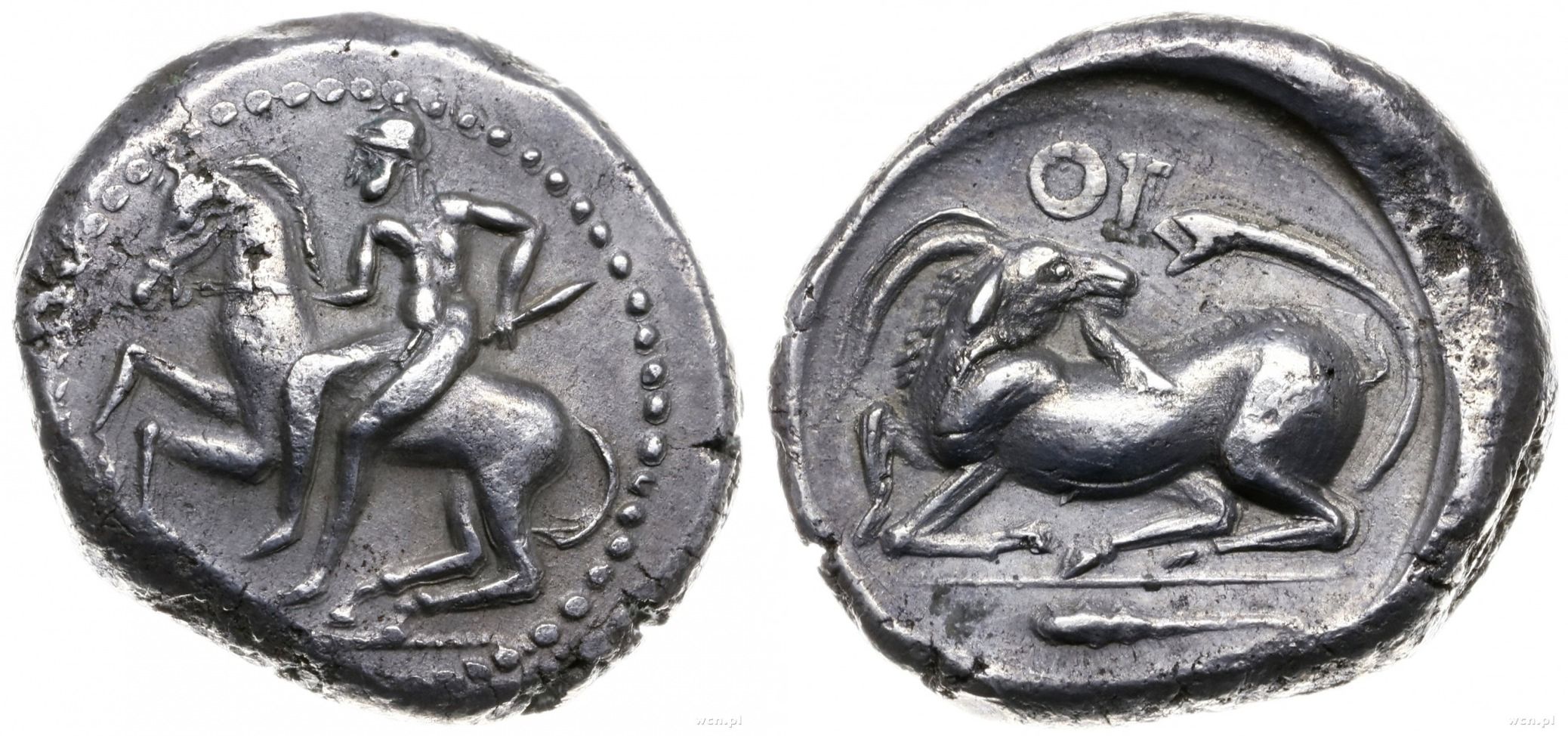

| Type 1 | |
| Denomination: | AR Stater |
| Obverse: | Helmeted (?), nude rider, holding reins in right hand and cutlass (makhaira) in left, dismounting from horse rearing to left on dotted exergual line; dotted border. | |
| Reverse: | Goat kneeling to left on solid exergual line, head turned back to right; in exergue, club. | |
| Variants: | a. | rev.: above goat, crescent and ivy leaf on a long stalk |
| b. | rev.: serpent attacking the goat from the right; above goat, OT | |
| c. | rev.: lizard on the right; above goat, OT | |
| References: | a. | SNG Berry 2, 1258 |
| b. | Vismara 1999, p. 162, Fr 39; several specimens on the market, e.g. Warszawskie Centrum Numizmatyczne, Auction 66 (10 September 2016), Lot 1 (acsearch.info URL); Coll. P. Veselý, PKE-AR-01 and PKE-AR-02 | |
| c. | Coll. P. Veselý, PKE-AR-03 | |
| Credit (see the references above): | ||
| a. | SNG Berry 2 | |
| b. | Warszawskie Centrum Numizmatyczne | |
| c. | P. Veselý (PKE-AR-03) | |
| Remarks: | (1) | The object in the rider’s left hand is not a whip, as is usually stated in auction catalogues, but a single-edged sword. See Veselý 2023, pp. 32–3. |
| (2) | Apart from the SNG Berry 2, 1258 coin shown here, I am not aware of any other specimen of variant 1a. The current location of this coin is unknown to me. Most of the coins from the Burton Yost Berry collection were donated to the American Numismatic Society and the Indiana University Museum of Art (now the Sidney and Lois Eskenazi Museum of Art at Indiana University). I have inquired about this coin at both of these institutions, but it is not in their collections. | |
| (3) | The model for variant 1a was probably the Kelenderis Type 2.6e. | |
| (4) | All known specimens of variant 1b are struck from the same obverse and reverse dies, which are a reworking of the dies used for the variant 1a. | |
| (5) |
The legend OT on variant 1.1b is clearly legible on the specimen PKE-AR-02 in P. Veselý collection. As for variant 1c, which is known from a single specimen so far, the upper part of the letter T is located on the edge of the obverse field, but is still partially visible, so this variant most likely also bears the monogram OT. The interpretation of this legend is unclear. It may be an abbreviation of the city that minted these coins, or the abbreviated name of the Persian governor who authorized this minting, or the monogram of the responsible mint official. Note that the OT monogram is also found on some Tarsos coins minted under Pharnabazos and perhaps also under Datames (Tarkumuwa), but is probably not related to these Pseudo-Kelenderis coins. See for example: staters: Heritage Auctions, Inc., Auction 232150 (15 December 2021), Lot 63140 (acsearch.info URL); Numismatik Lanz München, Auction 102 (28 May 2001), Lot 281 (acsearch.info URL); obols: Nomos AG, Auction 26 (21 May 2023), Lot 517 (acsearch.info URL); Classical Numismatic Group, Triton VII (12 January 2004), Lot 316 (acsearch.info URL). |
|
| (6) | The animal depicted on the right side of the reverse of variant 1c is most likely some kind of lizard. It has an open mouth, four short legs, and a long tail. Possible candidates include the starred agama (Laudakia stellio), also known as the roughtail rock agama, or the desert monitor (Varanus griseus). Both of these species live in Asia Minor, among other areas. | |
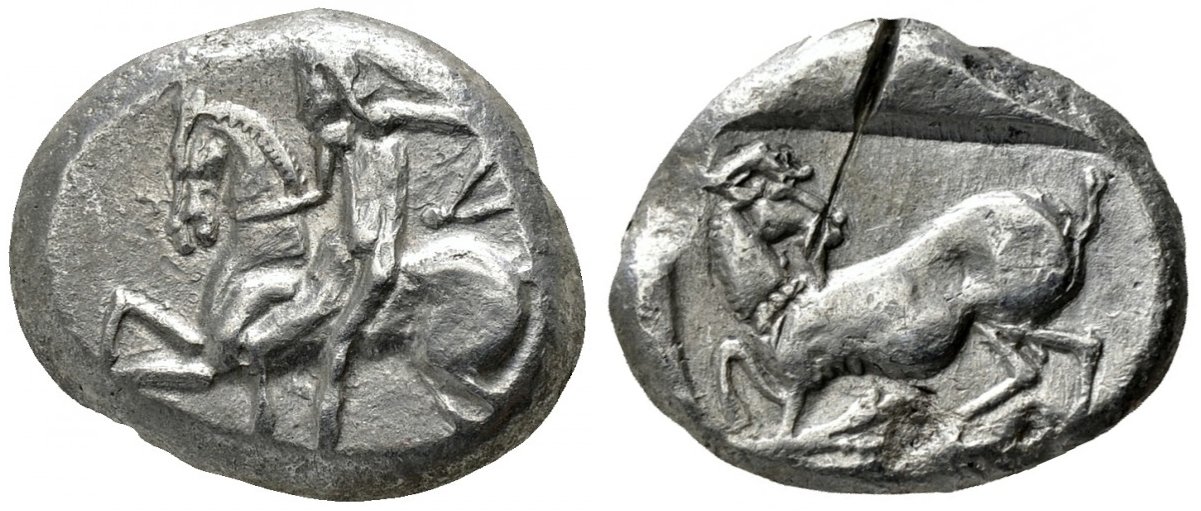
| Type 2 | |
| Denomination: | AR Stater |
| Obverse: | Nude rider, holding reins in right hand and whip in left, dismounting from horse rearing to left;. |
| Reverse: | Goat kneeling left on dotted exergual line, head turned back to right; all within deep incuse. |
| References: | Savoca Coins, Live Online Auction 4 (30 August 2015), Lot 322 (acsearch.info URL) |
| Credit: | Savoca Coins (see the reference above) |
| Remark: | The depiction of the rider on the obverse and the deep incuse on the reverse are strongly reminiscent of the style of early Holmoi staters, see the catalogue of Holmoi, Group 2, Type 1.1 (moreover, the variant 1.1a is also unepigraphic). The obverse scene is oriented to the right on these staters, but to the left on the third staters (ibid, Type 1.2). The kneeling goat on the reverse, however, refers to Kelenderis. The minting location of this coin is unclear, but most likely it is neither Holmoi nor Kelenderis. See Veselý 2023, pp. 34–5. |
Non-silver Staters
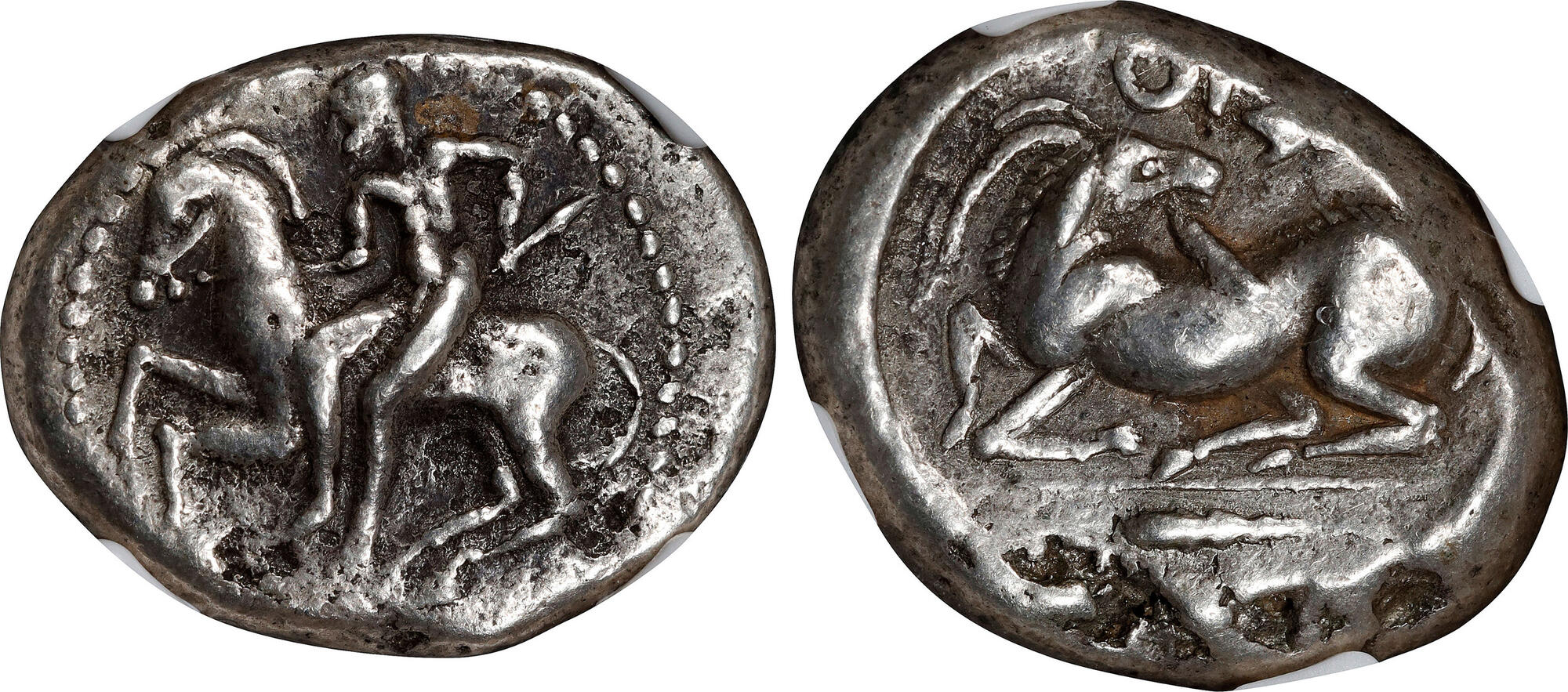
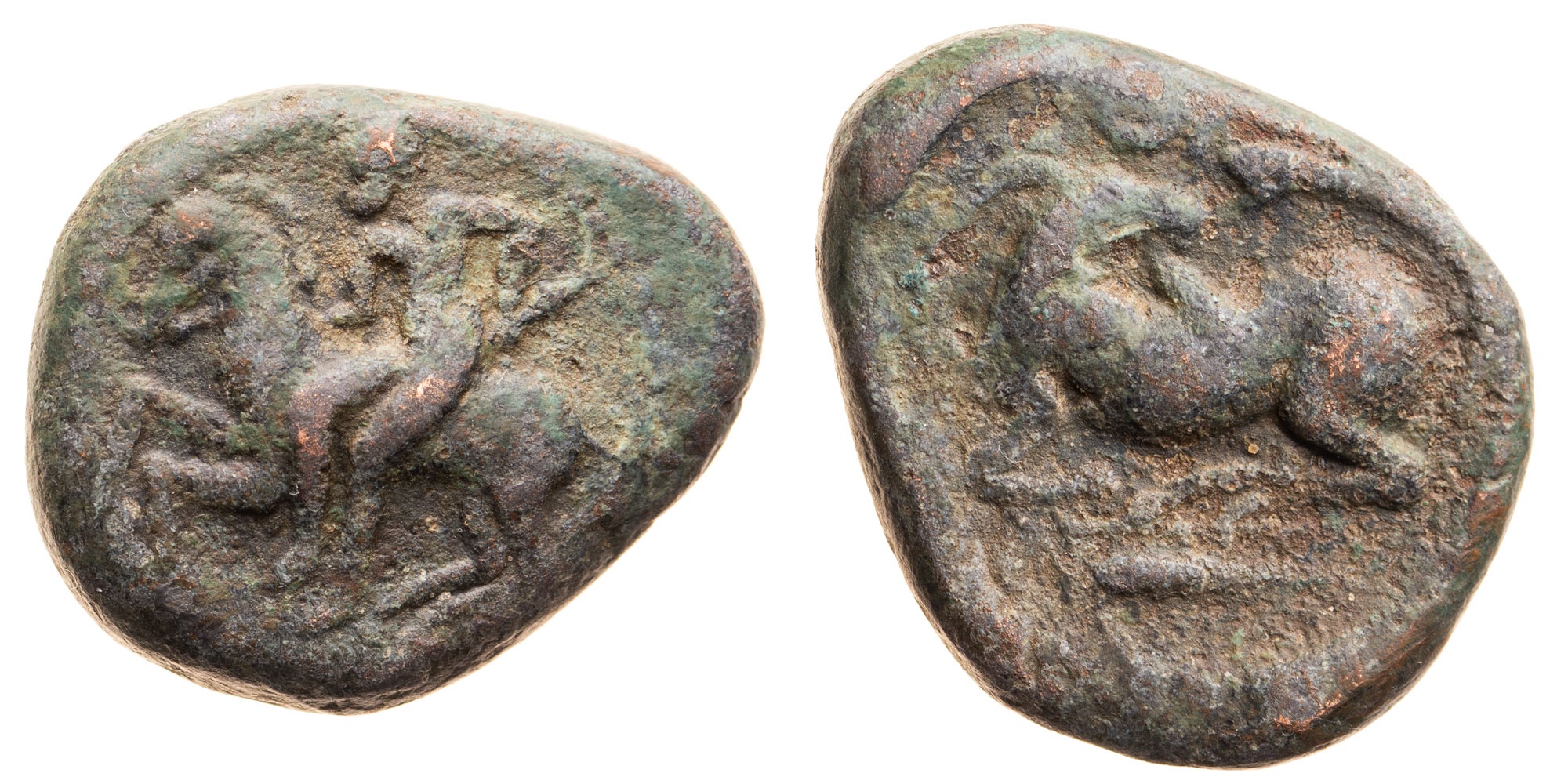
| Prototype: | Type 1b | |
| Denomination: | 1: | AR fourrée Stater |
| 2: | Lead (Pb) “Stater” | |
| Weight: | 1: | 10.71 g |
| 2: | 8.41 g | |
| Diameter: | 1: | unknown |
| 2: | 17–20 mm | |
| Obverse: | Helmeted (?), nude rider, holding reins in right hand and cutlass (makhaira) in left, dismounting from horse rearing to left; dotted border. | |
| Reverse: | Goat kneeling left on solid exergual line, looking back at serpent entwined around; above goat, OT; in exergue, club. | |
| References: | 1: | Stack’s Bowers Galleries, January 2023 NYINC Auction (13 January 2023), Lot 40076 (acsearch.info URL) = NGC Ancients, Cert # 5873943-003 |
| 2: | Coll. P. Veselý, PKE-PB-01 | |
| Credit (see the references above): | ||
| 1: | Stack’s Bowers Galleries | |
| 2: | P. Veselý | |
| Remarks: | (1) | NGC Ancients marked Specimen 1 as an AR stater, which is consistent with its weight of 10.71 g. However, according to the description in the auction catalogue of Stack’s Bowers Galleries, it is an AR fourrée stater, which it really appears to be based on the photograph. However, without physically examining this coin, it is impossible to determine this definitively. |
| (2) | The coin is made of lead alloy. An analysis of the alloy composition will be performed. | |
| (3) | Specimen 1 was struck from the same dies as all known coins of Type 1b. This is probably also true for Specimen 2, but it is not certain. This means that if Specimen 1 is indeed a fourrée, then it is an official mintage. | |
29 August 2021 – 5 February 2026